

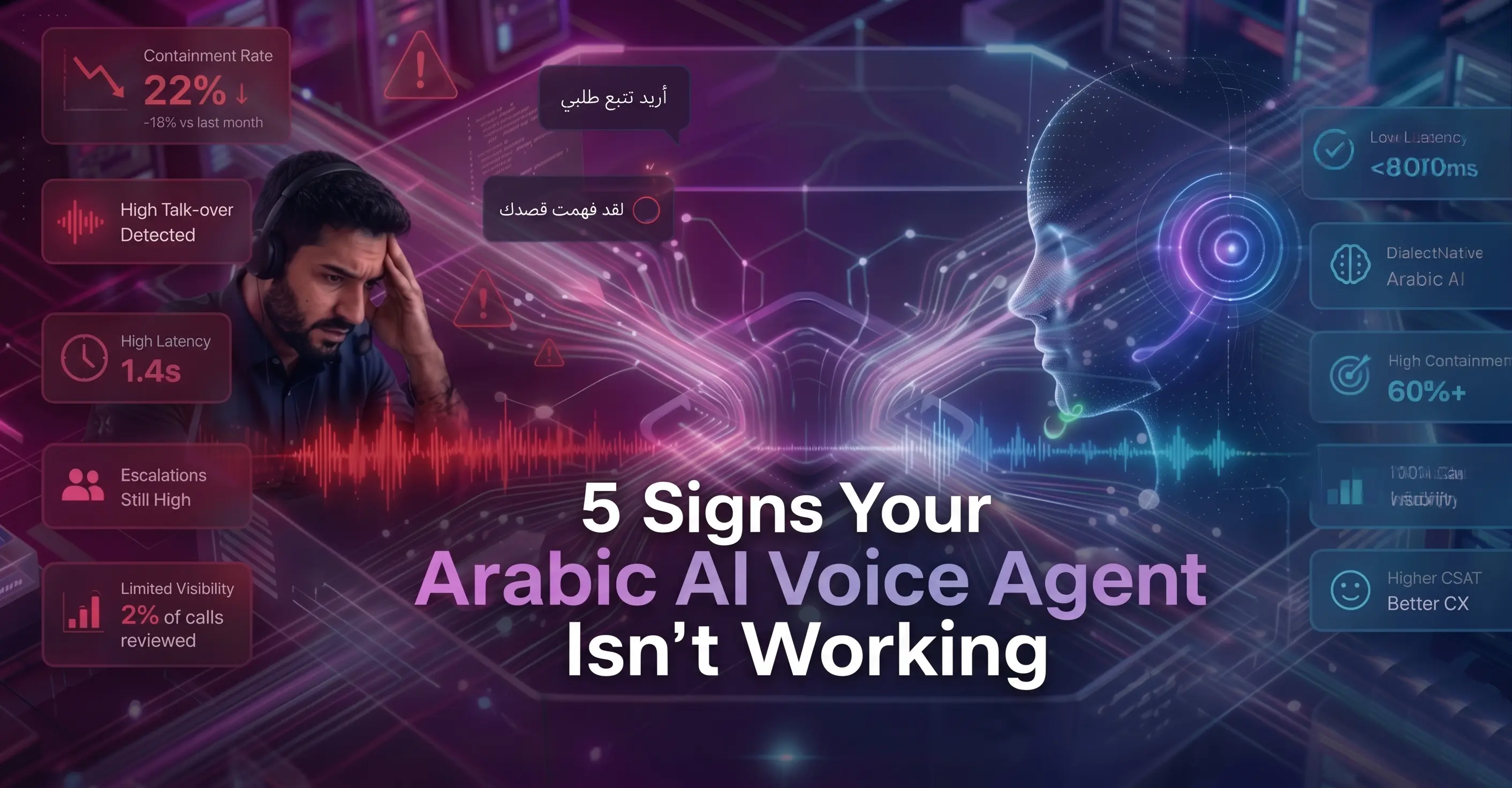
If you run contact center operations in Saudi Arabia, the UAE, Egypt, or anywhere across the region, watch for these five signs. Each issue points to a deeper problem with your AI customer service platform. Each one is fixable with the right AI contact center platform.
Here are the five red flags, what causes them, and what to do about each.
Sign 1: Your Containment Rate Keeps Dropping (Or Never Climbed)
Containment rate is the simplest health check for any AI voice agent. It measures the share of calls the AI handles end-to-end without human help. A healthy MENA deployment should sit above 40% within 90 days. Many vendors promise 60% or more.
If your number stays below 30%–or worse, drops–your AI fails to understand your customers.
The cause is almost always the same: dialect. Most AI voice agents train on Modern Standard Arabic (MSA). Your customers speak Khaleeji, Levantine, Egyptian, or Maghrebi.
The mismatch breaks intent recognition. The AI hands off. The metric collapses.
How to confirm:
- Pull a sample of escalated calls from one country
- Check whether the AI failed on dialect-specific phrases
- Look for code-switching moments – Arabic with English or French – where the AI lost context
How to fix it: switch to an AI customer service platform with dialect-native NLP customer service, not generic Arabic. ZIWO's natural language processing (NLP) stack covers Gulf, Levantine, Egyptian, and Maghrebi out of the box. It also delivers true multilingual support – Arabic mixed with English or French in the same sentence – without losing context. Custom conversational flows tied to your brand finish the job.
Containment rate climbs when the AI actually understands the customer. Not before.
Sign 2: Customers Keep Talking Over the AI
If your call recordings sound chaotic – customers cutting in, the AI replying mid-sentence, agents joking about 'the bot' – you have a latency problem.
In voice AI, silence is failure. Pause longer than 800 milliseconds and the customer assumes the call dropped. They start talking again. The AI replies anyway. The conversation breaks. CSAT drops with it.
The cause: most global vendors host inference outside the region. MENA voice traffic travels to Europe or the US, gets processed, then comes back. The round-trip kills the customer journey.
How to confirm:
- Ask your vendor for measured end-to-end response latency (ASR + AI + TTS)
- Listen to 10 calls and count the talk-overs
- Check where your vendor's models actually run
How to fix it: pick an AI contact center platform that hosts inference inside MENA. ZIWO runs everything in-region.
Sub-800ms response time. Real-time insights flow to live agents during the call. The result is reduced wait times across every channel and a virtual agent that feels like a real conversation, not a delayed echo.
If your customers are talking over the AI, the AI is not keeping up. That is fixable – but only with regional infrastructure.
Sign 3: The Same Routine Questions Still Hit Your Live Support Team
You bought an AI voice agent to take routine calls off your customer service teams. Six months in, the human queues look the same. Same questions. Same volumes. Same overtime.
That is a failure of contact center automation.
The cause is usually one of two things. Either the AI is too narrow – it handles only a tiny set of intents. Or it does not connect to your knowledge bases, so it cannot answer anything beyond a hard-coded script.
A capable AI voice agent should automate routine work end-to-end. Order tracking. Password resets. Appointment booking. Balance inquiries. Refund status. These should never reach a human in 2026.
How to confirm:
- Run a top-10 intent report from the last 30 days
- Identify which routine intents still escalate
- Check whether the AI is connected to live knowledge bases or just static FAQs
How to fix it: deploy a real AI customer service platform with agentic AI at the core. ZIWO's automation workflows handle full task chains, not just question-and-answer pairs.
The virtual agent ties into your knowledge bases, your CRM, and your back-office systems. So routine work gets done without a human in the loop. Your support team is freed for the complex calls only humans can handle.
Done right, this turns your service operation from reactive to scalable. Headcount stops growing in lockstep with call volume.
Sign 4: You Have No Visibility Into 90%+ of Calls
Quick test: how many of last week's calls did your QA team review?
If the answer is 2 or 3% – sampled by hand, like the old days – you are running blind. You have no idea what your AI is actually doing on the other 97% of calls. You have no idea what your humans are saying either.
The cause: legacy contact center operations rely on manual sampling. AI changes the math. Modern post-call analytics covers 100% of calls automatically.
How to confirm:
- Ask your QA lead what percentage of calls get reviewed
- Check whether you have sentiment trends, topic trends, or compliance flags by team
- Look at your AI vendor's reporting layer – does it surface actionable insights or just raw call counts?
How to fix it: turn on automated quality assurance for the contact center. ZIWO transcribes every call, scores every transcript against your scorecard, and flags issues automatically.
You get sentiment trends across teams and time. You get compliance gaps caught early. You get coaching opportunities surfaced for managers in real time.
That gives you actionable insights instead of guesses. Managers spend less time auditing and more time coaching. Quality goes up. Costs go down.
For Arabic and multilingual support operations, this only works if the underlying NLP stack actually understands dialects. Most do not. ZIWO's does.
Sign 5: Your AI Sounds Robotic and Customers Ask for a Human
Listen to a call. Does your AI sound like a person? Or does it sound like a 2010-era IVR doing a bad impression of one?
If customers ask 'can I speak to someone' within the first 30 seconds, you have a tone problem. The voice is wrong. The phrasing is stiff. The cadence breaks. Customers do not trust it.
There are three usual causes. First, generic text-to-speech voices that miss regional inflection. Second, scripted flows that ignore how Arabic conversations actually go. Third, no continuously improving model – the AI sounds the same on day one as it does on day 200.
How to confirm:
- Listen to 5 calls cold and grade the AI on a 1-10 'sounds human' scale
- Note customer requests for a live agent in the first 30 seconds
- Check whether your TTS offers regional voice options per market
How to fix it: choose a conversational AI platform that delivers customized experiences, not template scripts. The ZIWO Voice AI agent supports natural-sounding regional Arabic TTS voices and continuously improving models that learn from every call. Your product names, plan tiers, and regional terms get baked in over time. Customer journey nuances – formal address, polite phrases, local idioms – show up in the AI's replies, not just your human agents'.
The right voice changes everything. Customers stop asking for a human because the AI feels human enough.
Bonus Sign: You Cannot Tie Any of These Back to a Single Source of Truth
Most teams reading this list will recognize at least two of the five signs in their own operation. The bigger problem is that fixing them with five different vendors creates more failure points, not fewer.
A bolt-on transcription tool. A separate analytics dashboard. A third-party TTS engine. A fourth vendor for the IVR layer. Each one needs its own integration. Each one is a place data can leak, lag, or break compliance.
The way out: a single AI contact center platform that owns the full stack. Voice. Telephony. Routing. AI. Analytics. QA. Reporting. All under one roof. That is what an omnichannel AI platform should look like.
The ZIWO Difference
Most Arabic AI voice agents fail because they are bolted-on solutions. A model trained somewhere else.
A server running somewhere else. A QA layer that does not understand dialect. A TTS voice that sounds nothing like a real Saudi or Egyptian speaker.
ZIWO is different by design. It is the AI customer service platform built for MENA, in MENA. Voice, telephony, contact center, and AI in one stack. No middleware. No data leaving the region. No 'Arabic' SKU stapled onto an English product.
That tight integration is what makes our omnichannel AI platform deliver the best AI customer service software experience for the region. Our agentic AI handles routine work.
Our automated quality assurance covers every call. Our post-call analytics surface real-time insights for managers. Our virtual agent shares the same routing, recordings, and CRM as your human team.
The result for your contact center operations: higher containment, faster resolution, lower compliance risk, and a customer journey that feels native – not translated.
If any of the five signs above sound familiar, the issue is not your team. It is your AI contact center platform. Talk to ZIWO.
Frequently Asked Questions
What is the fastest way to tell if my Arabic AI voice agent is working?
Check your containment rate. If it is below 30% after 60 days, your AI is not understanding customers. The usual cause is poor dialect coverage or weak natural language processing (NLP) for code-switching.
Why are customers talking over my AI agent?
Latency. If end-to-end response time exceeds one second, customers assume the call dropped and start speaking again. The fix is regional hosting and lower-latency models.
How can I improve my AI voice agent's containment rate?
Three levers: dialect-native ASR, native knowledge base integration, and continuously improving models. The best AI customer service software handles all three by default.
Is automated quality assurance worth it for Arabic contact centers?
Yes. Manual QA samples 2 to 3% of calls. Automated quality assurance for the contact center covers 100%. For Arabic, it requires NLP customer service models that understand dialect – which is where most vendors fall short.
What key features should I demand from an AI customer service platform?
Per-dialect WER scores, sub-800ms latency, MENA hosting, native CCaaS integration, multilingual support, real-time agent assist, post-call analytics, and continuous fine-tuning on your data. Treat this list as your AI customer service buyer's guide.
Can AI voice agents handle Arabic mixed with English or French?
A good one can. Look for verified support for code-switching and custom conversational flows that maintain context across language switches.
Does AI replace my support team?
No. AI handles routine queries. Humans handle complex ones. Together they deliver customized experiences at scale and reduced wait times for the customer.
How long should it take to see results from a new AI voice agent?
Expect early wins in 30 days and a stable containment rate by day 90. If your numbers are flat after that, one of the five signs above is in play.
If your AI voice agent shows any of these five signs, do not patch around it. Replace the platform underneath. Your CSAT, deflection rate, and compliance team will thank you.


