

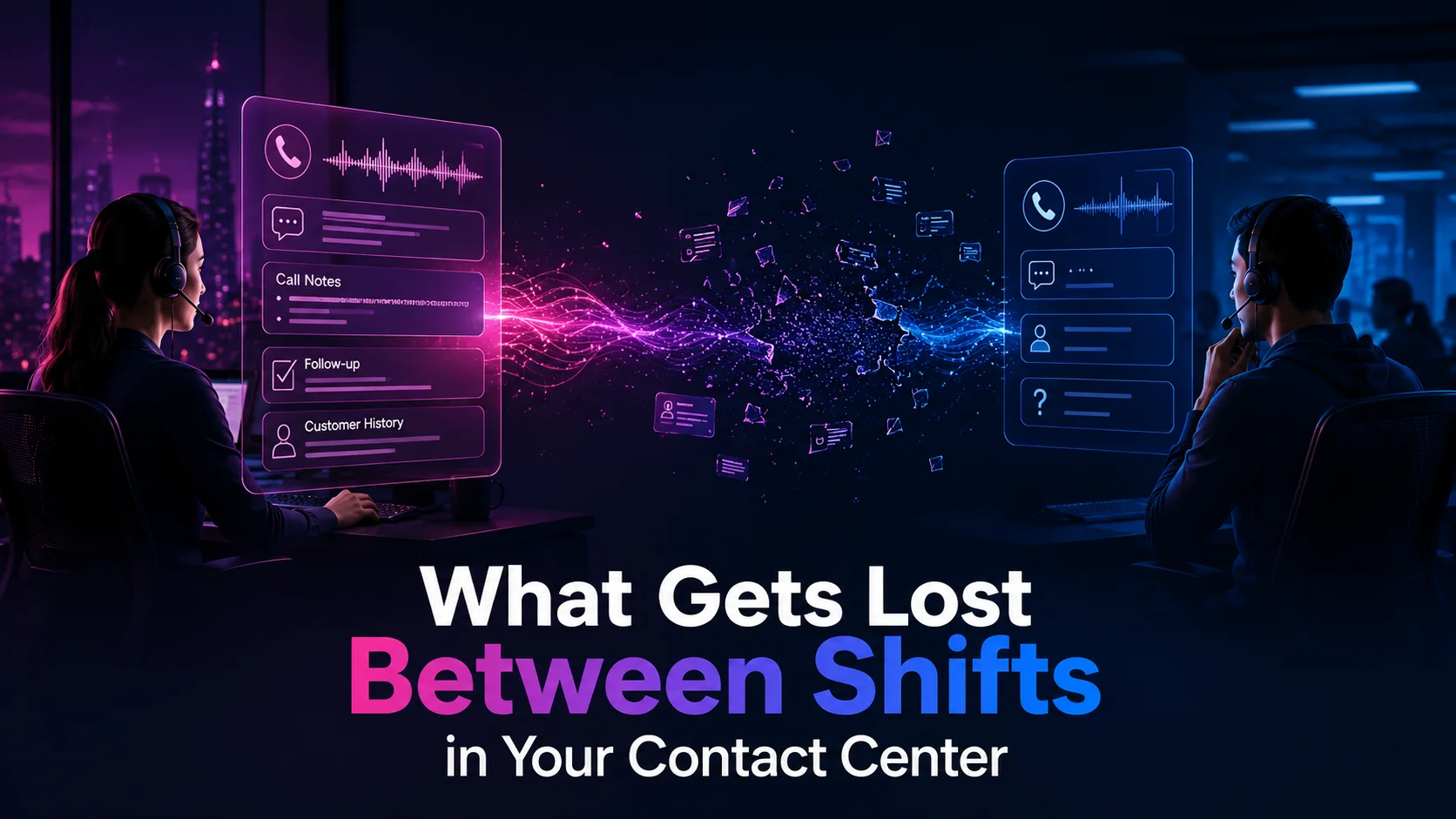
A customer calls at 9am. The agent listens, takes notes, makes a commitment. The issue isn't fully resolved, but the customer is told someone will follow up.
The shift ends. A new agent clocks in. The follow-up never happens.
The customer calls back. They explain everything from scratch. The new agent has no record of the previous interaction, no context, no idea a commitment was made. The customer is frustrated before the conversation has even started.
This is the shift handover problem. It happens in contact center operations every day, across every industry, and most operations have no idea how much it's costing them.
What a shift handover actually looks like
In theory, handing over between shifts is simple. The outgoing agent leaves notes. The incoming agent reads them. Cases continue smoothly.
In practice, it looks like this: a tired agent at the end of an eight-hour shift writes a one-line summary of a complex case. The incoming agent skim-reads it between calls. The nuance – the tone of the customer, the specific commitment made, the fact that this is their third call about the same issue – is gone.
Manual handovers depend entirely on the outgoing agent's memory, their note-taking habits, and the time available to document properly. At the end of a busy shift, none of those conditions are reliable. The result is a structural information gap that opens every single time the shift changes, which in a 24-hour contact center happens two or three times a day.
What actually gets lost
The information that disappears between shifts falls into four categories, each with its own cost.
Customer context. Who is this person? What have they called about before? Are they a high-value account, a first-time customer, a known escalation risk? This context should arrive automatically when the call connects. In most contact center operations, it doesn't – and if it wasn't captured in the previous shift's notes, the incoming agent starts from zero.
Case status. Where does this issue actually stand? Is it resolved, pending, escalated, or waiting on a third party? Without a clear case status, incoming agents either assume resolution when there isn't one, or re-open cases that were already in progress. Both create unnecessary work and frustrate customers who feel like they're going backwards.
Commitments made. This is the most damaging gap. If an agent promised a callback, a refund, a follow-up email, or a specific resolution by a specific date, that commitment lives in the customer's memory even when it disappears from the contact center's records. When the next shift has no record of it, the commitment is broken – not through bad intention, but through broken process.
Tone and relationship. Some customers need to be handled carefully. A previous agent may have built rapport, identified sensitivities, or noted that this customer is particularly anxious or frustrated. That intelligence rarely survives a shift change. The incoming agent walks into a relationship context they know nothing about.
Why it keeps happening
The shift handover problem persists because it's treated as a people problem when it's actually a systems problem.
Managers tell customer service teams to write better notes. Agents try, for a while. But note quality degrades under volume pressure. A contact center handling 500 calls a day cannot rely on individual agents to manually capture the right information, in the right format, at the right moment – consistently, across every shift, every day of the year.
The problem compounds in contact centers running across multiple time zones or languages. A handover between an Arabic-speaking day team and an English-speaking night team adds a language dimension to the information gap. Context that was captured in one language may not be fully understood or acted on by the team receiving it. Without multilingual support built into the platform itself, that gap widens with every shift.
CRM systems help, but only when they're used correctly and consistently. In most operations, CRM data quality degrades over time. Fields go unfilled. Notes are abbreviated. The system holds a partial record that gives the incoming agent a false sense of confidence: they checked the file, so they assume they have the full picture.
The cost of getting it wrong
The shift handover problem is a direct driver of three of the most expensive outcomes in contact center operations – and the industry data on the underlying metric is well established, even if handovers specifically are rarely broken out as a line item.
Repeat calls. SQM Group's longitudinal benchmarking, which tracks first contact resolution (FCR) across thousands of contact center interactions, puts the average FCR rate at roughly 70% – meaning close to three in ten calls require some form of repeat contact. Handover failures aren't the only driver of that gap, but they sit alongside incomplete resolution and unclear case ownership as one of the named causes. Repeat interactions of all kinds are estimated to consume close to a quarter of the average contact center's operating budget.
Escalations. A customer who has already explained their situation twice, and who calls back to find no record of either conversation, escalates. They ask for a manager. They threaten to leave. The operational cost of a single escalation – in agent time, supervisor time, and relationship damage – is several times higher than the cost of a well-handled first call. SQM Group's own commercial modeling suggests that even a 1-percentage-point improvement in FCR can save a mid-sized contact center on the order of $286,000 a year – a rough proxy for how much money sits inside the repeat-contact and escalation gap that handover failures feed.
Churn. The handover failure is invisible to the customer as a process. What they experience is a company that doesn't remember them, doesn't follow through, and can't be trusted to handle their issue. That experience drives churn more reliably than almost any single bad interaction, because it isn't one mistake, it's evidence of a systemic problem. The customer journey breaks not at one moment but across every touchpoint where context failed to carry over.
For a deeper breakdown of how to calculate what repeat calls specifically are costing your operation, see What Repeat Calls Are Really Costing Your Contact Center.
The industries where handover failures hit hardest
Healthcare. Patient calls about appointments, prescriptions, and referrals often span multiple interactions. A missed handover in a healthcare contact center isn't just a service failure, it can have clinical consequences. Patients who receive conflicting information from different shifts lose confidence in the provider entirely.
Finance and banking. Loan applications, account queries, and fraud investigations are time-sensitive and complex. A handover failure in the middle of a fraud case can mean a customer's account remains at risk while the new shift catches up. In lending, a missed follow-up can cost a conversion.
Telecoms. Fault resolution and plan changes often require multiple interactions over days. When the agent handling the case changes and the context doesn't transfer, the customer ends up repeating their issue to every new person they speak to. In high-competition telecom markets, that experience is enough to trigger a switch.
E-commerce. Order disputes, return requests, and delivery complaints are time-sensitive. A customer who was promised a refund by Thursday and calls back Friday to find no record of the commitment will not only churn – they will not return.
What AI changes about the handover
The shift handover problem is solvable. Not by training agents to write better notes, but by removing the dependency on manual note-taking entirely. Contact center automation handles what individual agents cannot do consistently at scale.
Automated call summaries. AI-powered contact center platforms now generate accurate call summaries automatically at the end of every interaction. The summary captures what was discussed, what was agreed, what action is required, and what the customer's sentiment was. It's available instantly in the CRM – not because an agent remembered to write it, but because the system did it automatically. This is contact center automation at its most practical: closing the handover gap without adding a single step to the agent's workflow.
Real-time CRM updates. Modern AI contact center platforms update the customer record during the call, not after it. When the shift changes, the incoming agent opens a file that reflects the current state of the relationship. Automation workflows trigger updates, confirmations, and follow-up actions the moment they're needed – not when someone remembers to log them.
Commitment tracking and automation workflows. AI can identify commitments made during a call. A promised callback, a specific resolution, a follow-up action, and flag them automatically for the next shift. Automation workflows ensure nothing falls through the gap because the service operation holds the commitment, not the agent. This is what agentic AI delivers in practice: systems that don't just record conversations but take action on what was said.
Intelligent screen pop with NLP. When a returning customer calls in, the incoming agent sees the full interaction history before the call connects – previous contacts, open cases, commitments made, sentiment history. Natural language processing (NLP) powers this intelligence, reading and categorizing prior interactions automatically. The handover happens in the two seconds before the agent says hello, not in a five-minute briefing that may or may not have happened.
Virtual agent handling for routine queries. An AI voice agent or virtual agent can handle routine inbound queries – status updates, balance checks, appointment confirmations – without any handover risk at all. When a query doesn't require human judgment, the AI voice agent resolves it end-to-end using NLP, accesses live knowledge bases, and automates routine interactions that would otherwise create handover complexity. Customer service teams are freed to focus on the cases that genuinely require human attention, with reduced wait times across the board.
Post-call analytics across shifts. AI-powered post-call analytics give supervisors real-time insight into what happened across the entire 24-hour operation. Patterns that would previously take weeks to identify – a spike in repeat calls on Monday mornings, a cluster of escalations following the weekend shift – surface automatically as actionable insights. Automated quality assurance reviews 100% of interactions across every shift, not just the sample a supervisor had time to listen to. The result is a continuously improving feedback loop where every shift makes the next one smarter.
Buyer's guide: key features for handover management
Not every AI customer service platform solves the handover problem equally well. If you're evaluating options, look for these eight capabilities.
Automated call summaries and CRM integration. The best AI customer service software generates summaries automatically and pushes them to your CRM in real time. If this step requires manual action, the handover gap remains open. Ask a vendor: does the summary push to CRM automatically, or does an agent have to save it?
Commitment and follow-up tracking. Look for an AI contact center platform that identifies and logs commitments made during calls, not just what was said, but what was promised and when. Ask a vendor: can the system flag an unresolved commitment to the next shift on its own?
Intelligent screen pop. Every incoming agent should see the full customer history the moment a call connects. A platform that surfaces this automatically – without the agent having to search – closes the handover gap before the conversation starts. Ask a vendor: is history surfaced automatically, or does the agent have to search for it?
Multilingual support. In MENA contact centers running across languages and dialects, multilingual support isn't optional. Your platform needs to capture, summarize, and surface context accurately across Arabic, English, and French, including regional dialects. Ask a vendor: does the platform summarize and surface context accurately across all our operating languages?
Omnichannel coverage. Handover failures happen across channels too, not just between voice shifts. An omnichannel AI platform ensures that context from a WhatsApp conversation carries into the next voice call, and vice versa. Ask a vendor: does a WhatsApp conversation's context carry into the next voice call?
Custom conversational flows. A conversational AI platform with custom flow builders lets your team automate routine handover steps – follow-up confirmations, case status updates, commitment reminders – without writing code. Every contact center has its own handover logic, so ask a vendor: can we build custom follow-up and confirmation flows without engineering resources?
Post-call analytics and automated QA. Manual quality assurance catches a fraction of handover failures; automated QA at the contact center level catches all of them. Ask a vendor: do we get real-time insights broken out by shift, agent, and issue type?
Agentic AI capabilities. The next generation of AI contact center platforms doesn't just summarize. It acts, booking the follow-up, updating the case, and flagging unresolved commitments automatically. That's the difference between a platform that records what happened and one that ensures what should happen next actually does. Ask a vendor: does the AI just summarize, or does it also take action on what was said?
Frequently asked questions
How common is the shift handover problem? Very. It isn't tracked as its own line item in most operations, but it sits inside a well-documented category: repeat contacts. SQM Group's industry benchmarking puts average first contact resolution at around 70%, meaning roughly three in ten customers need to call back about the same issue, and incomplete handovers are one of the recognized causes, alongside incomplete resolution and unclear ownership. Most contact centers don't measure the handover piece directly, which is part of why it persists.
Can an AI voice agent help with handovers? Yes, in two ways. An AI voice agent handles routine queries end-to-end, removing them from the handover equation entirely. For complex cases, AI generates the summary and CRM update automatically, so the handover is complete before the next agent picks up.
What's the fastest way to reduce handover failures? Automated call summaries and commitment tracking. Both can be deployed within weeks on a modern AI contact center platform.
Does this work across languages? With the right platform, yes. An AI customer service platform with strong multilingual support handles Arabic, English, and French interactions – including MENA dialects – and generates accurate summaries and context regardless of the language the call was conducted in.
The question worth asking
Pull your repeat call data and filter for calls that came in within 24 hours of a previous interaction. That's a working proxy for your handover failure rate. Benchmarked against SQM Group's industry average FCR of roughly 70%, most operations will find their number higher than expected.
The shift handover problem is not a training problem. It's a systems problem, and the best AI customer service software is built to solve it.
ZIWO's cloud contact center platform includes automated call summaries, real-time CRM updates, AI-powered post-call analytics, agentic AI automation workflows, and intelligent screen pop – all in a single omnichannel AI platform built for the Arabic, English, and French-speaking markets of the MENA region.
Book a demo and see how ZIWO closes the handover gap across your operation.


