

Every contact center has them. The caller who asks for a manager within two minutes. The customer whose name agents recognize before they even finish saying hello. The one who, no matter who picks up or what they're calling about, ends the call angrier than when they started.
Most contact centers treat these callers as a personality problem. They're not.
The angry escalator is a signal – one of the clearest signals a contact center produces – and most operations are too busy managing the escalation to read what it's saying.
The escalation that isn't about the customer
There is a category of caller who is genuinely difficult. Short-tempered, unreasonable, impossible to satisfy. They exist, and experienced agents know how to handle them.
But they are a small minority of escalations. The research is consistent: most escalations are not caused by difficult customers. They are caused by systems that failed those customers before the current call even began.
The customer who escalates on the first call usually has a legitimate complaint that wasn't handled correctly the first, second, or third time. The customer who always escalates is almost always someone whose journey through your contact center has been consistently broken – missed callbacks, wrong information, unresolved cases, agents who had no context. By the time they're asking for a manager, they've stopped expecting the problem to be solved. They're escalating because it's the only lever they have left.
That distinction matters enormously. A difficult customer needs handling. A customer who has been failed repeatedly needs fixing, and the fix isn't in the conversation, it's in the system that created the pattern.
What escalation data actually tells you
Escalations are one of the richest data sources a contact center produces, and one of the least analyzed.
Most operations track escalation volume and escalation rate. Some track resolution rate post-escalation. Very few track what happened before the escalation – the interaction history, the issue type, the number of prior contacts, the channel, the agent, the time of day.
That pre-escalation data is where the real intelligence sits.
When you analyze escalations at the pattern level rather than the incident level, three things become clear.
Escalations cluster around specific issue types. Billing disputes, service failures, and unmet commitments generate a disproportionate share of escalations. These aren't random – they're predictable. And predictable means preventable.
Escalations cluster around contact history. Customers who have called three or more times about the same issue are dramatically more likely to escalate on the next call. Not because they're more difficult, but because they've accumulated more evidence that the problem isn't being taken seriously.
Escalations cluster around process gaps. In most contact centers, a significant share of escalations happen at the same points in the customer journey – after a failed transfer, after a broken commitment, after a self-service interaction that didn't resolve. Those clusters point directly to the process failures generating the most damage.
None of this is visible in a standard escalation report. It only becomes visible when you analyze the full interaction history, which is exactly what AI-powered contact center platforms are built to do.
The cost of an escalation
Escalations are expensive in ways that rarely appear in a single line of a report.
The direct cost is the easiest to calculate. An escalated call typically takes two to three times longer than a standard interaction and involves at minimum two agents – the original handler and the supervisor who takes over. In a busy contact center, that supervisor time is pulled from coaching, monitoring, and managing the floor.
The indirect cost is harder to quantify but larger. Customers who escalate are significantly more likely to churn. A 2023 Qualtrics study found that customers who had to escalate to a manager were 3.5 times more likely to switch providers within 90 days than customers whose issues were resolved at the first point of contact. In MENA markets, where relationships drive purchasing decisions and recommendations travel fast, that churn rarely happens quietly.
There is also an agent cost. Handling an angry escalation is emotionally demanding. Agents who field a high volume of escalations – whether because of their queue position, their shift, or their skill set – experience significantly higher burnout rates. Burnout drives turnover. Turnover drives the recruitment, onboarding, and knowledge loss costs that contact center managers consistently underestimate.
Add it together and a single escalation that results in customer churn can cost five to ten times more than the original interaction was worth in operational terms.
The industries where escalation patterns hurt most
Telecoms. Billing disputes and service outages are the two highest-escalation issue types in the industry. Both are predictable. Both generate repeat contacts before they generate escalations. The escalation is rarely the first sign something is wrong – it's the last one before the customer leaves.
Finance and banking. Fraud alerts, loan rejections, and account restrictions are high-stakes, emotionally charged, and often poorly explained. Customers who feel they haven't received a clear or fair explanation escalate quickly. In financial services, the regulatory dimension adds further complexity – an escalation that becomes a formal complaint carries compliance implications beyond the service failure itself.
Real estate. Property transactions are the highest-value, highest-stress purchases most customers make. A contact center that handles real estate inquiries and support is managing customers at peak anxiety. A missed callback or conflicting information in this context doesn't just frustrate, it threatens the transaction.
E-commerce. Return and refund disputes generate a predictable escalation pattern: one contact for the initial request, one for the follow-up when nothing has happened, one escalation when the deadline has passed. The entire sequence is avoidable with proper case tracking and automated follow-through.
How AI identifies the angry caller before the call escalates
The shift from managing escalations to preventing them requires a different kind of intelligence – one that operates across the full interaction history, not just the current call.
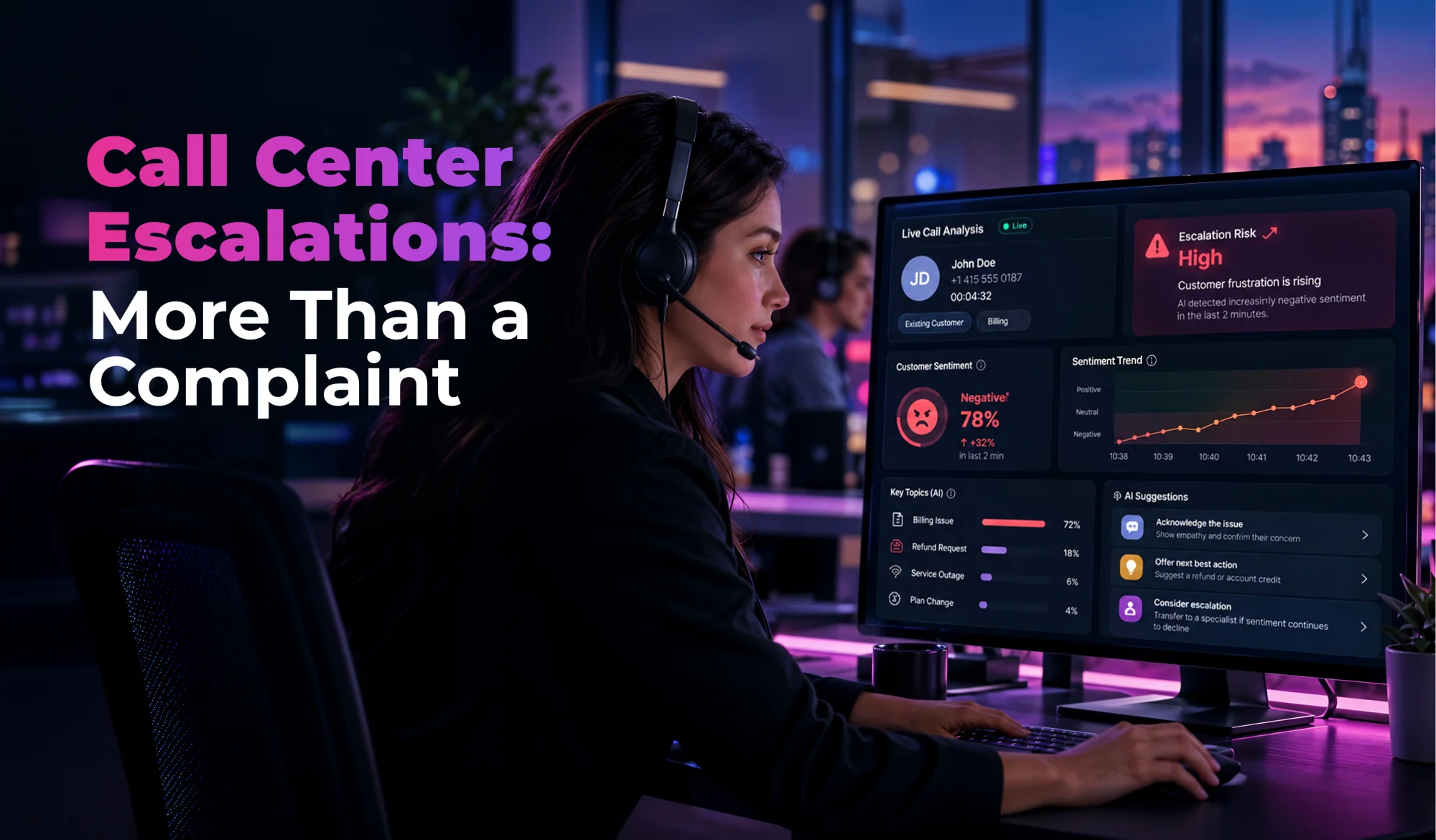
Sentiment analysis in real time. Modern AI contact center platforms analyze caller sentiment as the conversation unfolds. Rising frustration, specific language patterns, and tone shifts are detected automatically and surfaced to the agent or supervisor in real time. The agent knows a call is heading toward escalation before the customer has asked for a manager – and can intervene, de-escalate, or flag for supervisor support before the moment of breakdown.
Pre-call risk scoring. When a returning customer calls in, an AI-powered platform can assess escalation risk automatically based on their interaction history – number of prior contacts, issue type, unresolved cases, previous escalations – and flag high-risk callers before the agent picks up. The agent walks into the call prepared, not surprised.
Pattern detection across the operation. AI-powered post-call analytics identify escalation clusters automatically: by issue type, by agent, by channel, by time of day. A supervisor no longer has to listen to recordings to find the pattern. The system surfaces it, with the data to act on it.
Automated follow-through on commitments. A significant share of escalations are triggered by broken commitments: a callback that didn't happen, a resolution that was promised but never delivered. Contact center automation closes this gap by tracking commitments made during calls and triggering follow-up actions automatically. The customer doesn't need to call back to check. The loop closes before the frustration builds.
Agentic AI for resolution, not just conversation. The newest generation of AI voice agents doesn't just handle routine queries, it resolves them completely. An agentic AI system can process a refund, update an account, book an appointment, and send a confirmation without handing off to a human. When a query is fully resolved at the first point of contact, the escalation chain never starts.
What your escalation rate is really measuring
Most contact centers treat escalation rate as a measure of customer behavior. It isn't. It's a measure of system performance.
A high escalation rate tells you that your first-contact resolution is failing – that issues are arriving at the escalation point because they weren't resolved earlier in the journey. A clustering pattern in your escalation data tells you exactly where the journey is breaking down.
The question isn't how to handle escalations better. The question is why they're happening at the rate they are, and what in your operation is generating them.
First Contact Resolution (FCR) is the metric that sits at the center of the answer. Every escalation that could have been resolved at the first point of contact represents an FCR failure. Improving FCR – by giving agents better tools, better context, and better AI support – is the most direct route to reducing escalations sustainably.
Your AI customer service buyer's guide: what to look for
If you're evaluating AI contact center platforms specifically for escalation management, these are the key features that move the needle.
Real-time sentiment analysis. The platform should detect frustration and escalation risk during the call, not after it, and surface that signal to agents and supervisors in real time.
Pre-call history and risk flagging. When a customer calls, the agent should see their full interaction history and any escalation risk indicators before the conversation starts. An AI customer service platform that delivers this automatically gives agents the context to de-escalate before the situation develops.
Automated quality assurance. An automated quality assurance contact center tool reviews every interaction – not a sample – and flags the conversations that indicate process failures. This is how you move from incident management to pattern management.
Post-call analytics. Look for post-call analytics that surface escalation patterns by issue type, channel, and agent automatically. Real time insights from post-call data are what turn escalation reports into actionable intelligence.
Commitment tracking and automation workflows. Any promise made during a call should be logged, tracked, and followed up automatically. Automation workflows that close the commitment loop prevent the broken promises that drive repeat contacts and escalations.
Omnichannel AI platform coverage. Escalations often happen because context was lost between channels – a customer who messaged on WhatsApp and then called found that the agent had no record of the previous interaction. An omnichannel AI platform keeps the customer journey connected across every channel and every shift.
NLP customer service across languages. In MENA contact centers, natural language processing NLP must work accurately across Arabic dialects, English, and French. Sentiment analysis that fails on Khaleeji or Egyptian Arabic will miss the escalation signals that matter most in your market. Multilingual support isn't optional, it's operational.
Agentic AI for full resolution. The best AI customer service software doesn't just assist agents. It resolves queries end-to-end using agentic AI, so routine issues never reach the human queue where escalation risk is higher. Virtual agent and AI voice agent capabilities that handle queries completely – accessing knowledge bases, updating CRMs, triggering automation workflows – remove an entire category of escalation risk.
Frequently asked questions
Is a high escalation rate always a bad sign? Not always – a contact center that handles genuinely complex, high-stakes interactions will have a higher baseline escalation rate than one handling simple queries. What matters is whether your rate is trending in the right direction, and whether escalations are clustering around fixable process failures.
How quickly can AI reduce escalation rates? Contact centers that deploy real-time sentiment analysis and commitment tracking typically see measurable reductions in escalation rates within the first 60 to 90 days. The bigger gains come over time as post-call analytics surface the systemic patterns that generate escalations in the first place.
What's the right escalation rate to target? It depends on your industry and interaction complexity, but most well-run contact centers target an escalation rate below 5%. Anything above 10% consistently suggests a systemic issue with first-contact resolution, routing, or follow-through.
Can an AI voice agent handle a customer who is already angry? For routine queries, yes – an AI voice agent that resolves the issue immediately, without hold time or transfer, often de-escalates the situation naturally. For complex or emotionally charged interactions, the best AI customer service platforms detect escalation risk and route to a human agent immediately, with full context already surfaced.
Start with your escalation data
Pull your escalation records for the last 90 days. Filter for customers who escalated more than once. Look at their interaction history before the escalation. The pattern you find there – the issue types, the number of prior contacts, the broken commitments – is your contact center's improvement roadmap.
The angry caller isn't the problem. They're the symptom. The problem is in the data, and the data is already there.
ZIWO's cloud contact center platform includes real-time sentiment analysis, pre-call history and risk flagging, automated quality assurance, post-call analytics, and agentic AI automation – all in a single omnichannel AI platform built for the MENA region.
Book a demo and we'll show you what your escalation data is already telling you.


